
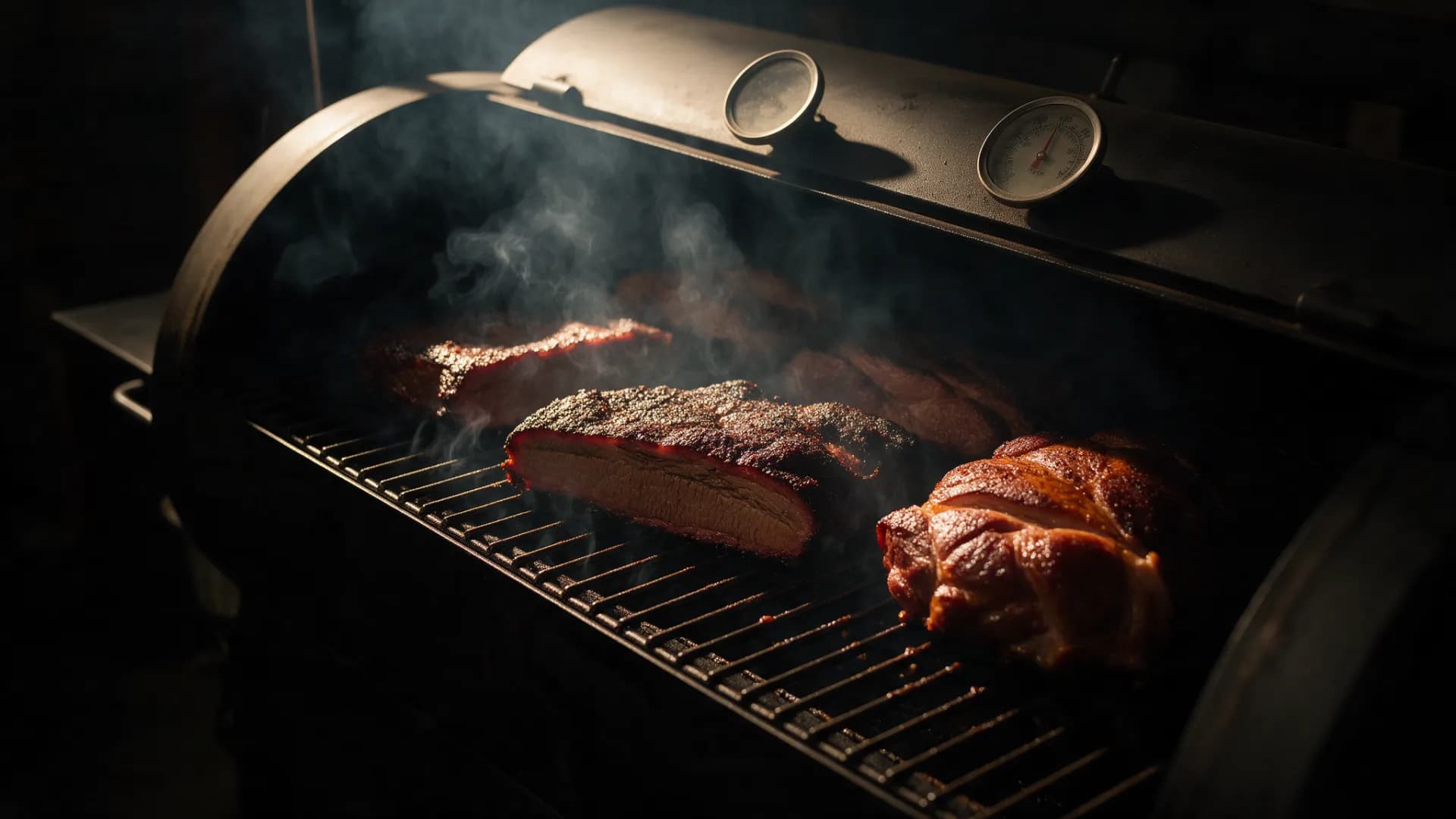
Why low and slow works
By Tim · 27 October 2026 · 10 min read · Last reviewed 28 October 2026
Brisket is tough because of collagen, the connective tissue wrapped around the muscle fibres. Collagen melts into gelatin with time at heat, not at one magic temperature, while the same heat squeezes water out of the fibres. A gentle cook gives the collagen time without drying the meat, so finish by feel, not a number.
On this page · 10 sections
Force to push a probe into the brisket centre (N). Lower is softer.
- 75°C, no hold113.3 N
- 75°C, 3 h hold60.5 N
- 85°C, no hold87.6 N
- 85°C, 3 h hold28.2 N
A 2.5 cm ball pushed 10 mm into the centre of the brisket. 96 briskets, commercial smokehouse, Kerth et al. 2025.
| Finished at | Held | Centre probe force (N) |
|---|---|---|
| 75°C (167°F) | no | 113.3 |
| 75°C (167°F) | 3 h | 60.5 |
| 85°C (185°F) | no | 87.6 |
| 85°C (185°F) | 3 h | 28.2 |
Why brisket is tough in the first place
Meat is bundles of muscle fibres held together in a wrapping of connective tissue, which is mostly collagen. In a tough cut it's that wrapping that needs the long cook, more than the meat inside it.
Hard-working muscles have more collagen, and so do older animals. Brisket is a chest muscle that holds the animal up, and in a study of 14 beef muscles it took about three times the force to cut raw as tenderloin, the toughest of the lot. Collagen's only a percent or two of the meat by weight, but it decides how tough a cut is. Which is why a tenderloin or a rib eye only needs cooking to how you like it, and a long cook just dries it out.
What heat does to collagen
Heat first makes collagen shrink and tighten. Then, given time, it melts into gelatin, and the gelatin lets the muscle fibres slide apart instead of holding them together. That's the difference between a slice that tears and one that bends.
Harold McGee puts the start of the melting at about 70°C (160°F). But it isn't a switch. Peter Purslow's 2018 review found that collagen gives way at about 62–67°C (144–153°F) when meat is heated fast in a lab, and from about 55–60°C (131–140°F) when it's heated slowly, like a slow roast. That's the scientific "slow" in low and slow. How far the collagen gets depends on how long the meat stays hot, not only on how hot it gets.
Melting collagen doesn't take enough energy to show up on your thermometer, either. There's too little of it, so it isn't what causes the stall (why your brisket stops climbing).
The catch is the muscle fibres
The heat that melts collagen also works on the fibres. As meat heats past about 60°C (140°F), the muscle fibres tighten and squeeze out water, and that's where most of the weight goes. One study found beef toughens in two steps as it heats, around 40–50°C (104–122°F) and again from 60–80°C (140–176°F), and the second step tracks the fibres. Above 70–80°C the fibres, not the collagen, are the main source of toughness in most meat.
So there's a built-in trade. McGee says there's no ideal temperature for a tough cut, only a compromise. It's also why a brisket can be tender and dry at the same time, with the collagen gone and the fibres squeezed out.
- Collagen: tightens, then softens into gelatin with time. Faintly from about 55°C when heated slowly, faster from about 70°C.
- Muscle fibres: tighten and squeeze out water from about 60°C on.
- Brackets under the line: the two steps of toughening one study found, 40–50°C and 60–80°C.
- Outline: probe tender on my briskets, 92–93°C (two cooks).
°C along the line. Dashed ends mean “about”: none of these starts at a sharp number.
What 96 briskets showed
In 2025 Kerth's team at Texas A&M smoked 96 whole briskets in a commercial smokehouse. They finished them at 75, 80, 85 or 90°C, then either chilled them straight away or held them at that temperature for three hours, and measured how soft they were, how much collagen had dissolved and how much meat was left.
Time stood in for temperature. A three-hour hold at 75°C (167°F) softened the centre of the brisket more than cooking on to 85°C (185°F) with no hold. The force to push a probe into the centre roughly halved with the hold, while going on to 85°C cut it by about a fifth. In the flat, dissolved collagen went from 13% to 32%, more than double, without the temperature going up at all.
| Finished at | Held | Meat left (hot yield) |
|---|---|---|
| 75°C (167°F) | no | 72.9% |
| 75°C (167°F) | 3 h | 62.2% |
| 85°C (185°F) | no | 63.2% |
| 85°C (185°F) | 3 h | 59.2% |
| 90°C (194°F) | 3 h | 55.7% |
Every hold cost meat. And longer has an end point. At 90°C with a three-hour hold the briskets were so soft they broke when hung off a table, and the point scored slightly less tender, likely because it was drying out. The authors' best balance was 85°C held three hours, as soft as 90°C with about 3 percentage points more meat. That's a smokehouse, mind, so read it as the direction and not a pull temperature for your pit.
If there's still a touch of resistance that's ok if you are long holding as the collagen conversion continues to happen as the brisket's internal temp falls to the holding temp. I've watched several YouTube videos that explain that Goldee's in Texas (and others) pull at 87°C (189°F) and hold for 24 hours, so that final collagen conversion happens over the hold. Kerth's holds were at the finishing temperature though, and none of the research behind this page measured it at a normal 60–65°C (140–149°F) hold.
Why a lower pit helps
Heat moves in from the outside. In one experiment in a 107°C (225°F) smoker, a brisket's surface ran about 11°C (20°F) ahead of its centre early on, and the hotter the pit, the bigger that gap gets. Which means the outside is drying while the middle catches up. A gentler pit gives the centre longer in the range where collagen softens before the outside overshoots.
That's reasoned from the studies above, though. Nobody has published a test of smoker temperatures, say 107°C against 135°C (275°F), on brisket tenderness. US food-safety advice keeps smoker air between 107 and 149°C (225–300°F).
I don't run one low temperature all day. I use what I call a Temperature Ladder, with the pit at 91°C (196°F) for the first couple of hours, then 107°C (225°F), then 121°C (250°F), and 135°C (275°F) from the wrap to the finish. Gentle early for smoke and rendering, progressively hotter to drive the finish. That's one way of doing it. Wrapping shortens the cook too, because it stops the brisket cooling itself by sweating (butcher paper vs foil).
Why probe tender beats a number
Because collagen softens with time as well as heat, two briskets can read the same temperature and be at different stages. The probe tells you how hot the meat is right now, not how long the collagen has been cooking.
There are a few key tells that show you if your brisket is done. One way is to temp probe both the flat and the point in their thickest parts, looking for 92–96°C (198–205°F). A lot of people rely on temp alone, which is fine, each to their own. But temp probe alone is risky because it fixes your mind on achieving a set number. Sometimes a brisket is done at 91°C, sometimes it's done at 97°C. Ideally you want to combine testing methods. In no particular order the other ways to test for doneness is feel, when you are probing for temp does it feel like a knife through hot butter or any resistance? Does the brisket jiggle when you shake it and does it bend a bit when you lift it.
My own cooks bear that out. My baseline brisket in July 2025 was still a little tough at 91°C (196°F) and probe tender at 93°C (199°F). The one before it was overcooked even though the probe read 96°C (205°F), and my note says "start probing earlier". On a brisket in July this year the lean still had resistance at 89.8°C (194°F) and was probe tender 25 minutes later at 92.3°C (198°F). And a mutton leg in August felt soft all over at 89.2°C (193°F), under the 90–93°C I'd been aiming for, so I pulled it. My note from that cook says "the number does not get a vote".
A toothpick can also be used in place of a probe, but it flexes and catches on the fibres, which can feel like resistance when a smooth metal probe would slide straight in. It can fool you the other way too. On a rack of ribs in August a toothpick slid in easily and the ribs were underdone, so I trust a thin metal probe more.
The researchers have a test that needs no thermometer at all. Kerth's team hung the end of each brisket over the edge of a table, and if it drooped to less than 45° the texture was acceptable. And in a study of a Texas restaurant's briskets, the pitmaster decided when each one was done. Researchers who need repeatable results do pull at a set number, but that's for comparing briskets with each other.
At your pit next time
- Thaw the brisket all the way through before it goes on.
- Start the pit gentle, somewhere in the 107–149°C range, and let it come up later in the cook if you like.
- Start probing early, well before you expect it to be done, in the thickest part of both the flat and the point.
- Pull when the probe slides in like hot butter in both muscles, whatever the number says.
- If you're holding it for a while, a touch of resistance is fine. Keep the hold at 60°C or above.
- Write down the temperature it went probe tender at. After a few cooks you'll know your own range.
Quick answers
What temperature does collagen break down in brisket?
There isn't one temperature. Collagen starts to soften in slow cooking from about 55–60°C (131–140°F) and dissolves into gelatin faster from about 70°C (160°F) up, but how far it gets depends on how long the meat stays hot. In a study of 96 smoked briskets, three hours at 75°C softened the centre more than going straight to 85°C.
Why is my brisket still tough at 95°C (203°F)?
Often because it got hot without spending long enough there, so the collagen hasn't finished turning to gelatin. A fast climb, a hot pit or a thick brisket from an older animal can leave it tough at a high number. If it's juicy but tough, it usually needs more time. If it's dry and tough, the fibres have likely overcooked, and more time won't fix it.
Does brisket keep getting more tender the longer you cook it?
Up to a point. In a study of smoked briskets, longer holds kept dissolving collagen and softening the meat, but each extra hour also cost weight. At 90°C with a three-hour hold the briskets were so soft they broke apart, and the point began to dry. So time helps until the collagen is done, then you're mostly losing juice.
Is it better to smoke brisket at 107°C (225°F) or 135°C (275°F)?
Nobody has tested it properly, because no published study compares smoker temperatures for brisket tenderness. The science suggests why lower helps. Heat moves in from the outside, so a hotter pit dries the surface while the centre catches up, and slow heating starts collagen softening earlier. Some cooks, me included, start lower and finish hotter. Either way, finish by feel.
What does "probe tender" actually mean?
A thermometer probe or thin skewer slides into the thickest part of the meat with almost no resistance, like a knife through hot butter. On my briskets that's happened at around 92–93°C (198–199°F), but the feel decides. Researchers have used a simpler test too. Hang the end of the brisket off a table, and if it droops below 45°, it's tender enough.
Read next
 Why your brisket stops climbingwhat's happening in the hours before it goes tender.
 Resting and holding a briskethow to hold it safely once it's done.
 Why is my brisket dry?when the fibres win.
For the curious
The melting of collagen into gelatin is collagen solubilisation, and the tightening of the fibres is protein denaturation. The brisket study is Kerth et al. 2025 in Meat and Muscle Biology, and its flop test is in the same paper. Purslow 2018 covers why slow heating lowers the temperature where collagen gives way, and Christensen et al. 2000 the two steps of toughening. The raw-muscle comparison is Torrescano et al. 2003, the restaurant briskets are Harris et al. 2017, and the 70°C figure and "no ideal temperature" are from McGee's On Food and Cooking (2004). Greg Blonder's melting fat page explains why gelatin lets the fibres slide. The smoker air range is from USDA FSIS.
If you're between Rockhampton and Bundaberg and would rather someone else stood at the pit for your next event, that's what I do. Get a rough price →