Food safety in low and slow
By Tim · 28 October 2026 · 11 min read
A long, slow smoke is safe for whole cuts like brisket, because their germs sit on the surface and the surface heats first. The risky hours come after the pull. Hold the meat at 60°C (140°F) or hotter. Below that you've got 4 hours in total. Fridge leftovers once they stop steaming, eat them within 2–3 days, and reheat to 75°C (167°F) once.
On this page · 14 sections
A brisket day, and where the risk sits
The meat’s centre, °C. A sketch of the shape, not a logged cook.
On the pit
After the pull: the risk
- 1Fridge
- 2On the pit
- 3Stall
- 4Wrap
- 5Pull
- 6Hold
- 7Serve
- 8Leftovers
1 Fridge · 2 On the pit · 3 Stall · 4 Wrap · 5 Pull · 6 Hold · 7 Serve · 8 Leftovers
- aWhole cut: the germs are on the surface, and the surface heats first, so it leaves the zone early. Low risk.
- bInjected, rolled or minced: the centre is the risk. It needs 75°C.
- cHold: 60°C or hotter in the meat. Probe it, not the dial.
- dBelow 60°C: the 4-hour clock starts.
- eCooling: portion it, and fridge it once it stops steaming.
- fLeftovers: 2–3 days. Reheat to 75°C, once.
Solid line: the meat’s centre. Red dashes: the danger zone’s edges, 5 and 60°C. Amber dots: 75°C.
What the danger zone actually is
Between 5°C (41°F) and 60°C (140°F), the bacteria that cause food poisoning can multiply to unsafe levels. Below 5°C they grow slowly or not at all, and above 60°C they can't grow easily. That's the danger zone, and the Australian food-safety bodies all use those numbers.
It isn't a cliff though. Growth is fastest in the middle, and time matters as much as temperature. The one to know about in barbecue is Clostridium perfringens, which Queensland Health says grows between 12 and 50°C, fastest around 43–47°C (109–117°F). And you can't smell, taste or see any of it.
Before it goes on the pit
Thaw it in the fridge, all the way. On the bench the outside warms into the danger zone while the middle is still frozen. And a half-frozen centre in the smoker spends far too long warming up. Put rubs, brines and marinades on in the fridge too.
You don't need to let a brisket come up to room temperature first. A big cut barely warms in an hour on the bench anyway, and the guidance is to keep it in the fridge until you need it. My 2.1 kg brisket this July went on at about 6°C straight from the fridge, no counter rest.
Is a long, slow climb safe?
For a whole cut, yes. The germs on a whole piece of meat are on the outside. The Food Safety Information Council says whole cuts carry contamination only on the outside, and SA Health says a whole cut can be rare in the middle once the surface is cooked. That's why a steak can be served pink.
In a smoker the outside heats first and fastest. Even the centre moves quicker than people think. On that July brisket the lean went from 6.6°C to 54.2°C in an hour and 22 minutes, about 35°C an hour, and on my first baseline brisket it went from 7°C to 40°C in the first hour. One cook each, but on my cooks the centre has climbed about 35°C an hour at the start.
So the hours a brisket's centre spends between 40 and 60°C on the way up aren't where the risk sits, as long as it's a whole cut nobody has pushed anything into. That's me reading the guidance, not a rule a regulator has written down. FSANZ doesn't set a time limit while food is being cooked. It just says keep it as short as possible.
Injected, rolled or minced meat is different
Once meat has been injected, rolled, minced, stuffed or tenderised with blades or needles, surface germs have been pushed inside. Then the centre is the risk, and it has to reach 75°C (167°F) in the thickest part. Poultry always needs 75°C too.
A brisket or pulled pork finishes at 90°C or more, so it passes easily even when it's injected (does injecting work?). Where the number bites is lamb, chicken, a rolled roast, or a probe sitting near the edge instead of the middle (where to put the probe).
| Meat | Australian minimum (centre) |
|---|---|
| Whole beef, lamb or kangaroo | 63°C (145°F), then a 3–5 minute rest |
| Pork steaks and pieces | 70°C (158°F); roasts 70–75°C |
| Poultry, mince, sausages, rolled meat | 75°C (167°F) |
| Injected or “moisture-enhanced” meat | 75°C (167°F) |
| Reheated leftovers | 75°C (167°F) |
Pink inside smoked meat doesn't tell you anything about doneness. The smoke ring stays pink however long you cook it (the smoke ring). Use a thermometer.
The 4-hour rule on the forums
You'll read that meat has to go from 4°C to 60°C within 4 hours in the smoker. Nobody seems able to find where that comes from. It isn't in the Australian Food Standards Code, and American cooks who searched their own Food Code couldn't find it either.
Even US guidance doesn't agree with itself. The USDA's smoking page says keep the smoker between 107 and 149°C (225–300°F). Its roasting page says never roast below 163°C (325°F), in case the food sits in the danger zone too long.
What does matter during the cook is simple. Keep the pit honest at about 107°C or more, have a probe in the thickest part of the meat, and don't let the fire die for hours while the meat's still climbing.
What if the fire dies overnight?
It comes down to how long the meat sat between 5 and 60°C. If your probe shows the centre of a whole, uninjected cut was already above 60°C and stayed there, it's in a much better spot, so get the fire going and carry on. If it dropped below 60°C, Australian guidance on cooked food gives it 4 hours in total. Past that, or if you can't tell how long it's been, throw it out.
There's no Australian page about a smoke that stalls out halfway, so that's the cooked-food rule applied carefully. Don't cool a half-cooked brisket to finish it another day either. The USDA warns that partly cooking meat lets the bacteria that survive multiply.
A probe that logs its lowest reading answers the question for you. Mine records the minimum and maximum for every session, and that's what I'd check first.
Holding it hot
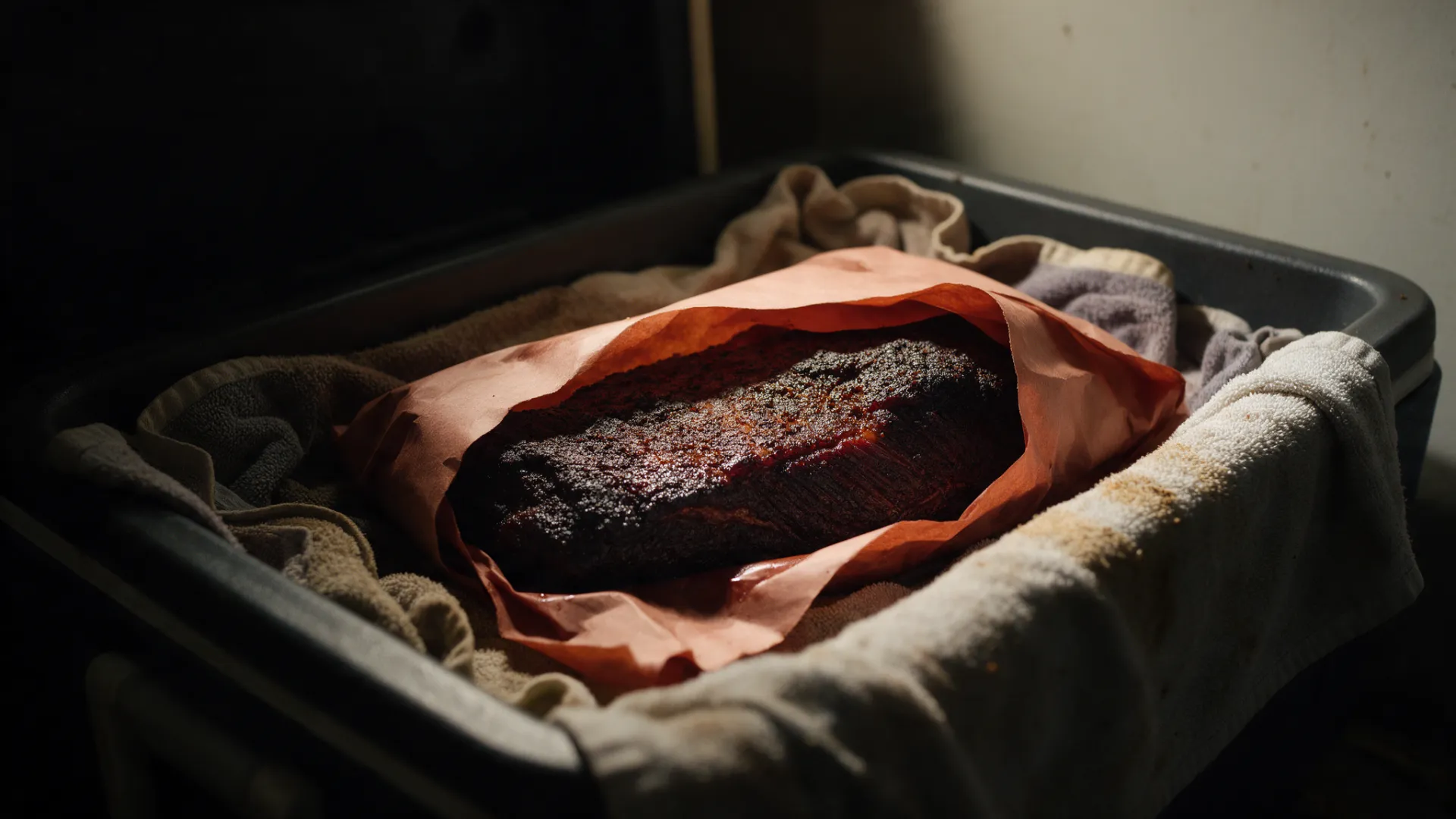
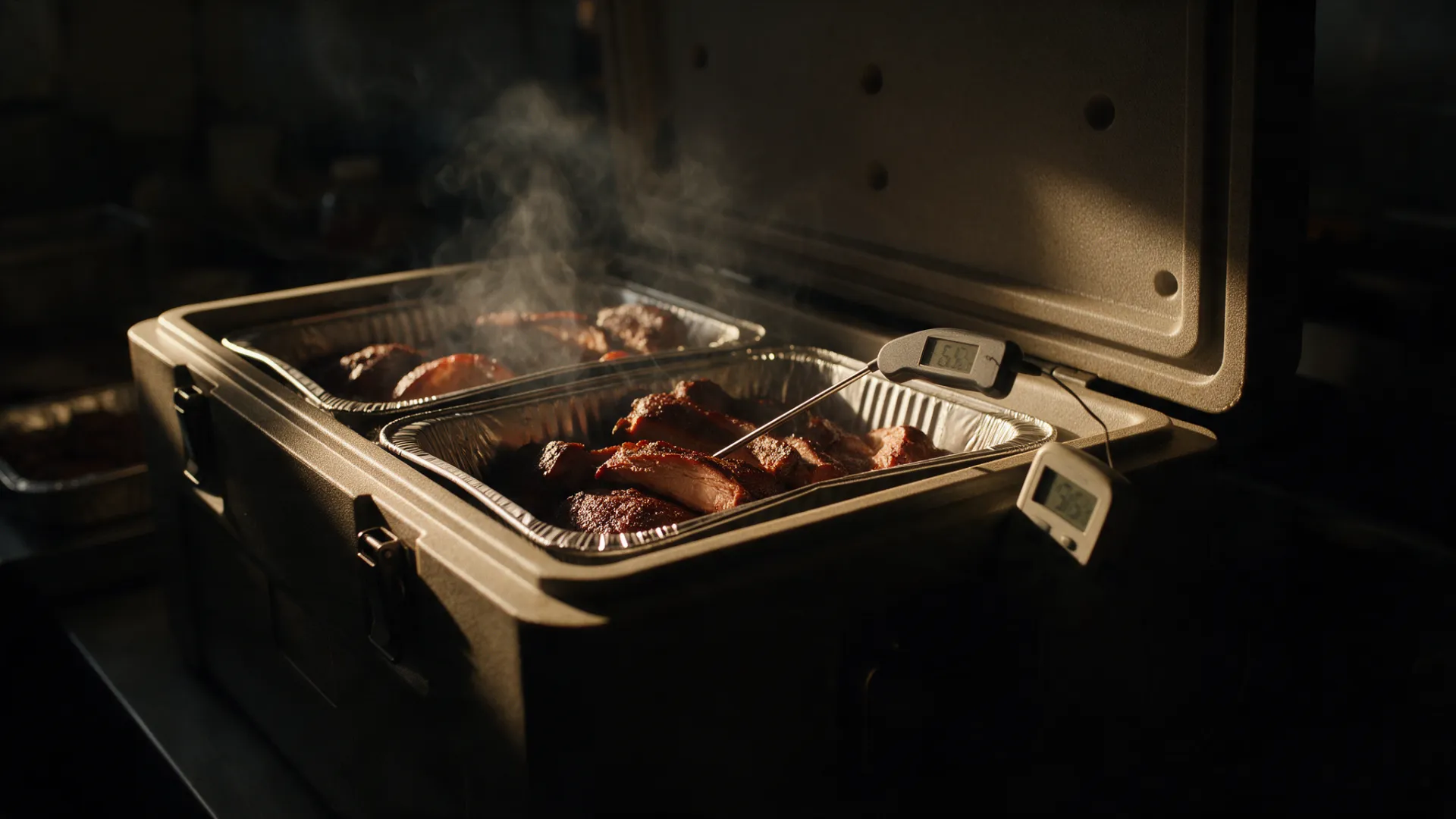
Holding means the meat at 60°C (140°F) or hotter, checked with a probe in the meat. The oven dial doesn't count. I hold at 65°C which is a food safe temp and slice to order so it stays hot and juicy. That 65°C (149°F) is what I set the oven air to, and it's the meat I check.
I ran an experiment in July with a benchtop oven as a holding box, and the dial said 63–65°C. The brisket was cooling too fast for that, so I put a probe in the oven air and it read 57.2°C. The meat had told me before the thermometer did. I turned it up before the lean got down to 60°C, then overdid it the other way (resting and holding a brisket has the whole story).
Once the meat drops below 60°C, the clock starts. In Queensland summer heat it's tighter again. Health units here advise just 1 hour for food left out once it's over 32°C (90°F).
Cooling down is where long cooks go wrong
Cooling is the bit most people skip. Clostridium perfringens survives cooking as spores. As the meat cools back through the danger zone, the spores wake up and grow, fastest at 43–47°C. Big pieces of meat cooled slowly are the classic cause of outbreaks.
A whole brisket or leg left on the bench, or even put in the fridge whole, cools far too slowly. As a rough illustration, left whole, even in the fridge, a joint this size would take hours to get below 21°C (70°F). Sliced into shallow containers it's a fraction of that. So slice or portion it, spread it out, and put it in the fridge as soon as it stops steaming. Freeze what you won't eat in time.
Cooling on purpose can work, if you watch the clock. I cooled a mutton leg on purpose in August and reheated it in the oven before carving, and on my projected timings it spent well under 4 hours below 60°C. I didn't log the lowest temperature though. That's one cook, and it's in the holding article too.
Caterers work to a stricter business rule. Cooked food goes from 60°C to 21°C within 2 hours, then to 5°C within another 4.
Leftovers and reheating
Eat leftovers within 2–3 days. FSANZ's own fact sheet allows up to 4, and the Food Safety Information Council says 2–3. I go with 2–3.
Reheat until the centre hits 75°C (167°F), steaming hot all the way through, and only reheat it once. Use the oven, the microwave or a pan. A slow cooker or a warming tray heats too slowly. Reheated brisket is safe done right but it's never quite as good. In one 2024 study consumers scored reheated brisket lower than fresh on everything.
With leftovers I'll often rewarm them in a bath of gravy and make up sandwiches. Or I'll put the leftovers on a pizza, make a pasta dish or sometimes just eat it cold! Whichever way, anything I reheat goes to 75°C in the middle.
As for how long leftovers sit out, about 30 to 60 minutes is about right, it can get contaminated pretty quickly. The official line is the 2-hour/4-hour rule above.
Who needs extra care
Pregnant women, babies and young children, older people and anyone with a weakened immune system are more likely to get seriously ill. For them, serve the meat hot and fresh. Leftovers within a day, and cold sliced meat reheated until it's steaming hot first. Listeria can grow in the fridge, which is why cold leftovers are the ones to watch for these guests.
At your pit next time
- Thaw in the fridge, all the way, and put it on cold.
- Keep the pit at about 107°C or more and the fire alive.
- Probe the thickest part. Anything injected, rolled, minced or poultry needs 75°C in the centre.
- Hold at 60°C or hotter, checked in the meat with a probe.
- If it drops below 60°C, note the time.
- Slice or portion leftovers into shallow containers and fridge them once they stop steaming.
- Eat within 2–3 days, and reheat to 75°C, once.
The Australian numbers
- 5°C
Fridge at or below. The bottom of the danger zone.
FSANZ
- 60°C
Hot-held meat at or above, checked with a probe. The top of the danger zone.
FSANZ
- 63°C
Whole beef, lamb or kangaroo, then a 3–5 minute rest.
Food Safety Information Council
- 70°C
Pork steaks and pieces (roasts 70–75°C).
Food Safety Information Council
- 75°C
Poultry, mince, rolled or injected meat, and reheating leftovers.
FSANZ, Food Safety Information Council
- 2 h
Under 2 hours in total between 5 and 60°C: you can still refrigerate it.
FSANZ 2-hour/4-hour rule
- 4 h
2–4 hours: eat it, don't keep it. Over 4: throw it out. Hot food has 4 hours from dropping under 60°C.
FSANZ
- 2–3 days
Leftovers in the fridge. FSANZ allows up to 4; 1 day for pregnant or vulnerable guests.
Food Safety Information Council; FSANZ for the 4 days
Quick answers
Is it safe to smoke meat at a low temperature for a long time?
Yes, for whole cuts like brisket or pork shoulder. Their bacteria sit on the surface, which heats quickly in a smoker, so a slow-rising centre isn't the main risk. Keep the pit at about 107°C (225°F) or hotter, use a probe in the thickest part, and don't let the fire die for hours. Injected, rolled or minced meat is different, and its centre must reach 75°C (167°F).
My fire went out overnight. Is the brisket still safe?
It depends on how long the meat sat lukewarm. There's no Australian rule written for an interrupted smoke, so apply the cooked-food rule. If a probe shows a whole, uninjected cut stayed above 60°C (140°F), carry on cooking. If it fell below 60°C, that rule allows 4 hours in total. Past that, or if you can't tell how long it's been, throw it out. Don't cool a half-cooked brisket to finish another day, because interrupted cooking lets surviving bacteria multiply.
How long can smoked brisket rest or sit out?
Kept at 60°C (140°F) or above, in a warm oven and checked with a probe, it can be held for hours. Once it's below 60°C, eat it within 4 hours in total, and put any leftovers in the fridge within 2. In Queensland summer heat, Queensland health units advise just 1 hour out in total once it's over 32°C (90°F).
How long do brisket leftovers last in the fridge?
Eat them within two to three days. Australian sources differ a little, and FSANZ's own fact sheet allows up to four. Slice or portion the brisket into shallow containers and refrigerate it as soon as it stops steaming, then freeze anything you won't eat in time. For pregnant or vulnerable people, eat leftovers within a day.
What temperature should I reheat leftover brisket to?
Until the centre reaches 75°C (167°F), steaming hot all the way through, and only reheat it once. Use the oven, microwave or a pan rather than a slow cooker or warming tray, which heat too slowly. A splash of the cooking juices, stock or gravy keeps the slices from drying out.
Do I need to let meat come to room temperature before smoking?
No. A large cut barely warms in an hour on the bench anyway, and Australian guidance is to keep meat in the fridge until it's needed, so put it on cold. What matters is that it's fully thawed. A frozen centre spends far too long warming up in a smoker, which is why thawing in the fridge comes first.
For the curious
The danger zone and the rules for holding, cooling and reheating are in FSANZ's temperature control requirements (Standard 3.2.2), the 2-hour/4-hour rule, cooling and reheating food and thermometers. The 4 hours for hot food that drops below 60°C is time as a control, from Safe Food Australia Appendix 2. The consumer pages are FSANZ's food safety basics, Clostridium perfringens (3–4 days) and vulnerable people. Spore growth temperatures are from Queensland Health. Cooking temperatures are on the Food Safety Information Council's safe cooking temperatures poster and leftovers on its leftovers page. Thawing and whole cuts are from SA Health. The US pages are FSIS on smoking and roasting. Fresh versus reheated brisket is Johnston et al. 2024 in Meat and Muscle Biology. Pages checked 26 October 2026, apart from the FSIC leftovers page and Safe Food Australia, which were checked for earlier articles.
If you're between Rockhampton and Bundaberg and would rather someone else kept an eye on the probe for your next event, that's what I do. Get a rough price →