
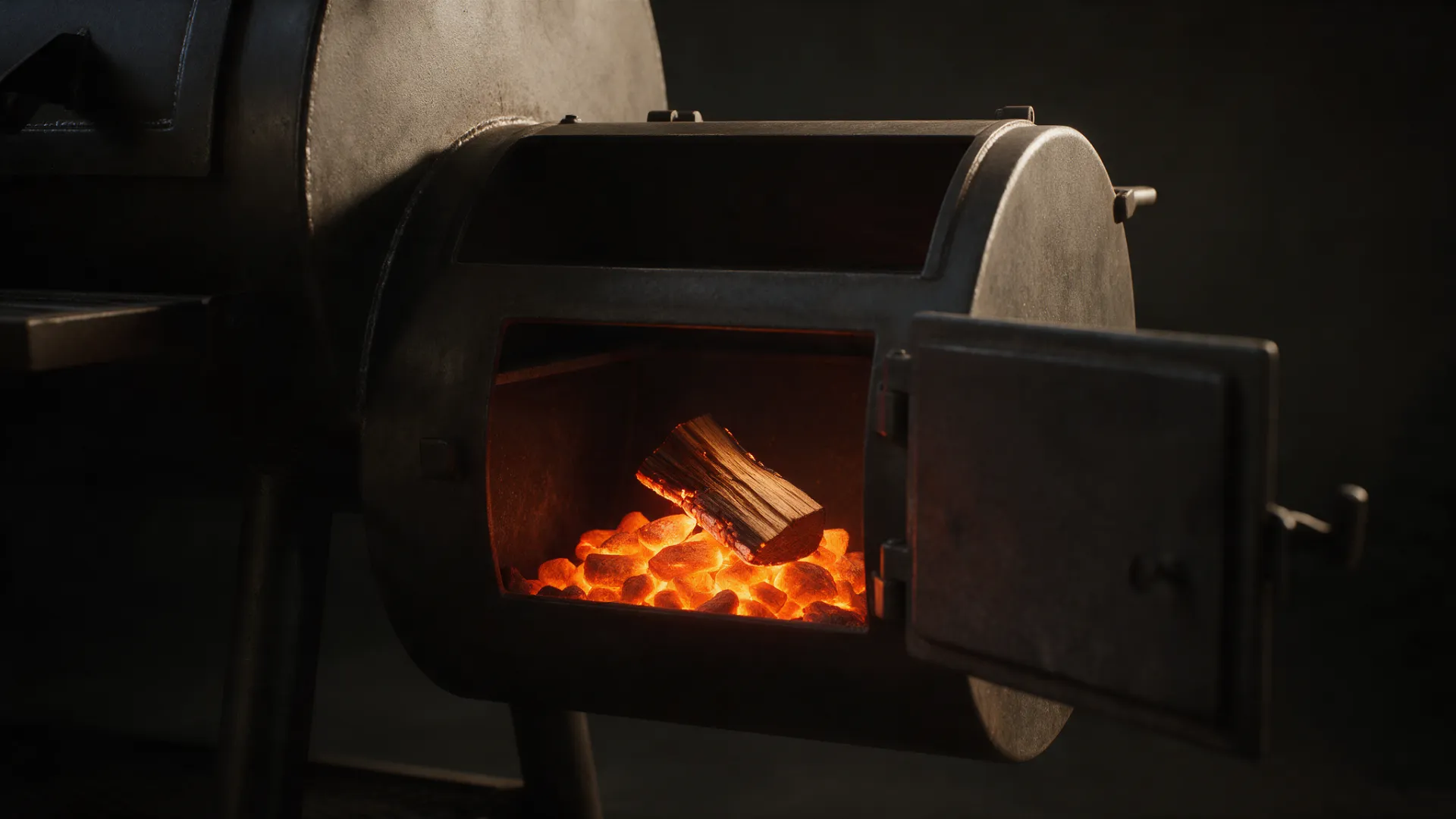
Running a thick-steel offset: what the steel does, and how to drive it
By Tim · 28 October 2026 · 12 min read
A heavy offset's steel stores heat, which is why it rides out a door opening or a cold split without the chamber collapsing. It doesn't insulate though, so wind still strips heat off it and it won't save a fire you fed late. Leave the chimney open, steer with the firebox intake, add wood before the temperature drops, and then leave it alone.
On this page · 13 sections
What does all that steel actually do?
It stores heat. Every kilo of mild steel holds about 0.47 kJ for each degree it warms up, and a heavy offset has a lot of kilos. My Hark Texas Pro-Pit is about 130 kg going by retail listings, so the whole pit stores roughly 60 kJ for every degree. The air inside holds next to nothing by comparison.
| What's in the pit | Heat stored per °C |
|---|---|
| The whole Hark (about 130 kg, treated as all steel) | about 60 kJ |
| A 4.7 kg packer brisket | about 15 kJ |
| A 2.1 kg flat | about 7 kJ |
| 1 litre of water in the pan | about 4 kJ |
| A whole cubic metre of hot air | under 1 kJ |
So think of the steel as a battery. It charges up while the pit comes to temperature, and when you open the door or throw on a cold split it gives heat back to the air while the fire catches up. The air's really just carrying the heat from the fire to the meat. It's a battery with a leaky case though, because heat goes straight through steel and out the other side.
The price of all that stored heat is that a heavy pit is slow to come up and slow to answer. You can't nudge it quickly, so you steer early and in small amounts. Hark's manual says 30 to 45 minutes to get the coals going. I light my charcoal about 90 minutes before the meat goes on, so the whole pit, steel included, has come up and settled (clean smoke covers why that helps the smoke too).
Does thicker steel make an offset better?
Steadier, yes. Better at keeping heat in, not really. Steel conducts heat really well, so the outside of the pit is nearly as hot as the inside. What actually slows heat leaving is the thin layer of still air sitting on the outside of the pit, and that air resists heat hundreds of times more than a few millimetres of steel does. Which means an extra millimetre or two of wall barely changes how fast heat leaks out. What it changes is how much heat is stored. A 6 mm wall stores twice what a 3 mm one does, so it's slower to swing and slower to recover.
Aaron Franklin puts good smoker steel at 1/8 to 3/8 inch, about 3 to 10 mm. Hark doesn't publish a thickness for the Texas Pro-Pit. And I can't tell you a thick pit burns less wood, because I haven't found anyone who's measured it. What does cut fuel is real insulation (firebrick, mineral wool, a double wall) and keeping the wind off.
I've run the same temperature ladder on a cheap thin-walled offset as well as the Hark.
Leave the chimney open, steer with the intake
The fire pulls air in through the firebox vent, the hot gas runs the length of the chamber past the meat and goes out the chimney at the far end. That pull is the draft.
Stack open, intake is the throttle.
- Air in at the firebox intake: low down, into the coals. The intake is the throttle: the one control you move.
- Hot gas along the chamber: the fire's pull draws it the length of the chamber, past the meat. That pull is the draft.
- Out the chimney: left fully open, so the draw stays strong and there's only one control to read.
- The steel: a heat battery: about 60 kJ for every °C across the whole Hark. It stores heat; it doesn't insulate.
- Wind on the outside: strips heat about 2.5 times as fast as still air at 18 km/h, 4 times at 36 km/h and 5 times at 52 km/h (textbook figures for a flat steel surface, not measured on a pit).
- Two grate probes, one at each end: on the Hark they've read about 3°C to 17°C apart. Read the gap, and watch the far one.
A drawing, not to scale. Amber is air, fire and hot gas. Red is heat lost off the outside.
Hark's own manual calls the stack damper a rain cap and says the air damper down at the firebox is the temperature control. I leave the stack fully open and only ever move the intake. Two reasons. A choked chimney slows the draw, so smoke and combustion gas hang around the meat longer. And if you move two controls you can't tell which one changed the temperature. Some cooks on reverse-flow cabinets do it the other way and steer with the chimney, and that works for them. On a standard offset, one control is simpler.
Don't keep the intake choked down either. The manual says keep it at least a third to half open for clean burning, and Franklin says it's better to let heat out or push the coals back than slowly choke a fire. A starved fire is a smoky one.
When should the next split go on?
Before the temperature drops. On my 26 July brisket I kept putting wood on once the pit had already fallen, and it sawtoothed between 82°C and 124°C (180–255°F) on a cycle of about 30 to 40 minutes. My note from that cook says the depth of each dip measures how late the log went on. A decayed coal bed has to be rebuilt before the new split can carry the box.
So the fix is to watch one cycle and add the next split at about two-thirds of it, around 20 to 25 minutes on that cook. I haven't nailed it yet. On the next cook in August I was about 5°C late again.
On 8 August, with the pit sagging, I opened the intake wide. It only gained 1°C, and if opening the throttle wide produces almost nothing, the fire is short of fuel, not short of air. So it got a split. If it climbs fast instead, the fire was being starved. Once the split's on, ease the intake back to about half, because a fresh split on full air will overshoot.
Dry, small splits warmed beside the firebox catch fast. A cold or wet one sits there fuming and soaking up heat while it dries out (Australian smoking woods). And load the pit slightly hot. My note from that mutton cook says "120°C is the target running temperature, not the target loading temperature", because a fridge-cold leg pulls the pit down when it goes in.
Why does my offset keep swinging?
Usually it's fuelling late, fiddling too much, or wind. The fiddling one surprised me. On 8 August the pit held 115–122°C (239–252°F) for 27 minutes while I left it alone, a band of about 7°C. Then over the next 42 minutes of re-feeding and adjusting it went from 99°C to 123°C (210–253°F), a band of about 24°C.
The dips in that trace are narrow and V-shaped, which looks like door openings, though I never matched them to what I was doing at the time. And it was only 27 minutes, one fuel cycle. A trace always looks flattest just before it's tested. Still, what I took from it was fewer, bigger, better-timed fuel events rather than lots of small ones. If you've got to open the lid, have everything ready first so it only opens once.
The other thing is that a steady number isn't really the goal. A brisket's middle doesn't feel a ten-minute swing. What the swing tells you is that the fire's decaying, and a decaying fire is when the smoke goes dirty. I try to manage the fire and let the number follow.
Reading the pit with two probes
An offset chamber isn't one temperature. In a 2019 University of Southern Queensland project that measured a reverse-flow offset, one zone averaged about 21°C cooler than the zone above it. On the Hark my two grate probes have read anywhere from about 3°C to 17°C apart.
So I leave one probe at the grate toward the firebox end and one toward the stack end, and try to keep them in the same spots every cook, and watch the gap. On 8 August it was about 3°C at 105–120°C (221–248°F), opened up to 14.8°C when the pit was running about 133°C (271°F), and came back to about 3°C at 105°C (221°F). The gap grows as the fire works harder, so it only means something when you know the pit temperature it was read at. On 26 July it went the other way, with the far side 12 to 17°C hotter, and the probes may not have been sitting in the same places, so I can't explain that one yet.
Watch the probe furthest from the fire. On 8 August the one near the firebox read higher and flatter, and it flattered me. It said a stable 130°C (266°F) while the far probe was swinging that 24°C. The hood gauges won't tell you either. Even if the hood gauges are reasonably the same the grate temp is a whole different ball game (where to put the probe).
What do you do when it runs hot?
Ride out a small overshoot first. 10 to 15°C over costs very little, I reckon. Then stop feeding. Then open a door to let heat out. The one move I don't make is closing the intake hard on a hot coal bed, because that's what turns a clean fire dirty. The overshoot is temporary and the dirty smoke is permanent. Hark's manual lists closing the air damper or opening the lid as the two ways to cool it down, and I go for the door first.
On the mutton cook I walked away and it peaked at 155°C (311°F). I shed it by opening the doors, and I changed two vents at the same time too, which is three changes at once. Fine in a recovery, not a habit. It cost nothing because the leg was sealed in a tray of stock, which can't climb much past 100°C while there's liquid in it. A bare brisket wouldn't have got off so lightly.
If your offset has an ash tray that slides out for a big air boost, never leave it open unattended. The pit runs away fast.
Wind, and when the fire matters most
Moving air strips heat off the outside of the pit much faster than still air. Going by textbook figures for a flat steel surface, it's about 2.5 times as fast in an 18 km/h breeze, 4 times at 36 km/h and 5 times at 52 km/h. A windbreak beats chasing it with the intake. Franklin says turn the firebox door away from the wind, and on a cold morning spread a few coals toward the back of the firebox to warm the air coming in.
When a dip happens matters as much as how big it is. On 26 July an early sag cost the brisket nothing. During the stall the same kind of sag had the lean falling about 28°C an hour. After the wrap it cost almost nothing again. So I try to feed hardest through the stall, and if I have to step away I do it after the wrap (why your brisket stops climbing).
Stepping the pit up through a long cook
I don't run one number. On a packer I start at 91°C (196°F) for the first two hours, then 107°C (225°F), then 121°C (250°F), then 135°C (275°F) from the wrap. That's my temperature ladder. Each step is a fire change, so I make it early and small, because the steel takes a while to answer. The manual's smoking range is 100–125°C (212–257°F), so the ladder starts under it and finishes over it, well inside the pit's 260°C (500°F) maximum. I suspect, but haven't shown, that the low start is behind the extra smoke on some cooks (why low and slow works).
At your pit next time
- Light up early enough for the steel to settle, not just the coals.
- Leave the chimney open and only move the intake, a little at a time.
- Watch one fuel cycle, then add each split at about two-thirds of it.
- Pit sagging? Open the intake wide. If it barely moves, it needs wood.
- Put one probe at each end of the grate and watch the far one.
- Running hot? Wait, stop feeding, then open a door. Don't choke it.
- Put up a windbreak before you need it, and do your best fire work through the stall.
Quick answers
Should I control my offset with the intake or the chimney?
Most offset cooks, and Hark's own manual, leave the chimney fully open and steer with the firebox intake. A choked chimney slows the draw, so smoke and combustion gas hang around the meat, and moving two controls makes it impossible to know which one changed the temperature. Some cooks control with the chimney on reverse-flow cabinets. On a standard offset, keep the stack open and make small intake changes.
Does thicker steel make an offset better?
It makes it steadier, not much more efficient. Heavy steel stores a lot of heat, so a door opening, a cold split or a gust barely dents the chamber before the fire recovers. But steel conducts heat well, so a thicker wall barely slows heat escaping from the outside, and it takes longer to heat up. Real insulation and a windbreak are what cut fuel use. Thickness buys you time to react.
How often should I add wood to an offset?
There's no fixed interval, because it depends on split size, the wood and how hot you're running. Watch one cycle. Note how long the pit takes to peak and start falling after a split goes on, then add the next one at about two-thirds of that time, before the temperature drops. Waiting for the dial to fall means rebuilding a cooling coal bed, which is what makes the pit sawtooth.
Why does my offset's temperature keep swinging?
Usually it's fuelling late, fiddling too much, or wind. A split added after the pit has already dropped has to rebuild the coals before it can lift the chamber. Each door opening can show up as a sharp dip. And wind strips heat off the outside several times faster than still air. Add wood earlier, open doors less, put up a windbreak, and judge the pit from a grate probe on the far side from the firebox.
Can I use my offset during a fire ban in Queensland?
Assume not. The Queensland Fire Department's current guidance says barbecues and pizza ovens that burn solid fuel such as timber are prohibited during a fire ban, while gas and electric units can be used if they're contained and attended. Ban declarations are worded area by area and have differed, so check the declaration for your council area before you light up.
For the curious
How much heat a material stores per kilo per degree is its specific heat, and how easily heat passes through it is its thermal conductivity. Steel is dense, so a wall of it stores a lot, and it conducts well, which is why it's a battery rather than a blanket. The still air on the outside of the pit is the boundary layer, and for a 6 mm wall it resists heat flow about 560 times more than the steel. Wind thins it, which is forced convection. Greg Blonder measured the oxygen in offset exhaust and found it fell from 21% to only about 19%, so most of the air going through never touches the fire (wood fuel for barbecue).
The steel and air figures are from Earle and Earle's Unit Operations in Food Processing. The measured chamber gradients are Tait 2019. Franklin's steel, wind and fire advice is in Franklin Barbecue: A Meat-Smoking Manifesto (2015). The fire-ban rule is on the Queensland Fire Department site, and the manual's figures are from Hark's owner's manual.
Read next
 Clean smoke: thin blue vs thick whitewhat the fire does to the smoke.
 Where to put the probegetting a grate reading you can trust.
 Why your brisket stops climbingwhy the stall is when the fire matters most.
If you're between Rockhampton and Bundaberg and would rather someone else minded the fire for your next event, that's what I do. Get a rough price →