
Dry brining: how salt really gets into meat
By Tim · 28 October 2026 · 10 min read
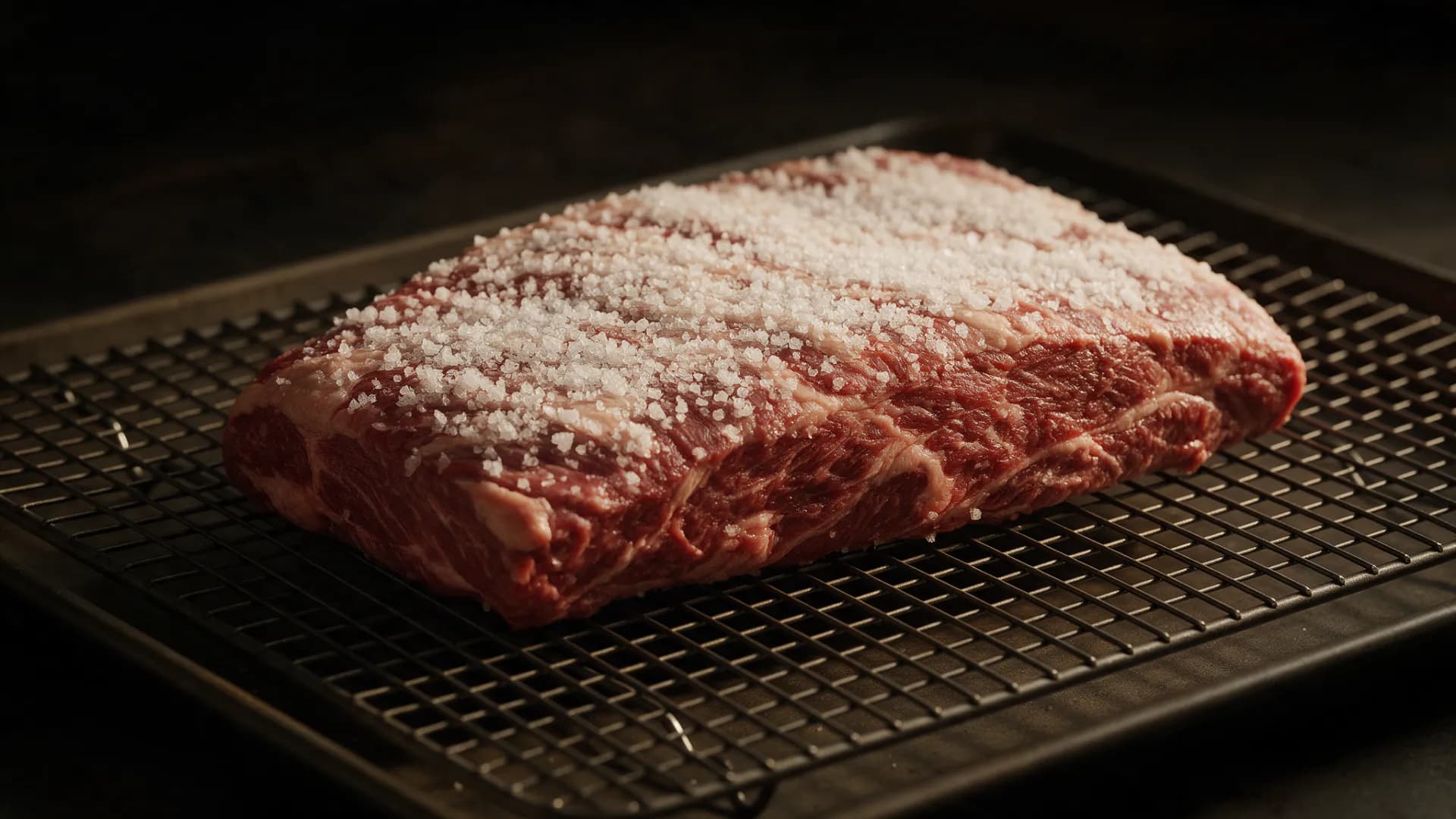
Dry brining is salting raw meat and leaving it in the fridge before you cook it. The salt doesn't soak in, it creeps, roughly 5–6 mm overnight, so on a brisket it seasons the outer half-centimetre or so. Use about 5–10 g of salt per kilo of meat. Only the salt travels, so the rest of the rub can go on later.
On this page · 12 sections
How far salt gets in, mm from the surface, over hours
- In the fridge, ≈1–5°C (34–41°F)
- Room temperature, for comparison only, ≈21°C (70°F)
- At the side: a brisket flat is several centimetres thick
- Overnight (12 h) in the fridge: about 6 mm
- Two days (48 h) in the fridge: about 1 cm
Hours along the bottom, millimetres up the side. “Gets in” means the salt has reached a tenth of its strength at the surface. No line during the cook: nobody has measured the rate at cooking temperatures.
See the depths as a table
| Hours | Fridge | Room temperature |
|---|---|---|
| 1 | 1.7 mm | 3.4 mm |
| 3 | 3.0 mm | 5.9 mm |
| 12 | 5.9 mm | 11.8 mm |
| 24 | 8.4 mm | 16.7 mm |
| 48 | 11.8 mm | 23.7 mm |
| 72 | 14.5 mm | 29.0 mm |
Diffusion rates: fridge 1.5 × 10⁻¹⁰ m²/s (Betiol 2026), room temperature 6 × 10⁻¹⁰ m²/s (Vestergaard 2007), both measured in pork.
What you see on the bench
Sprinkle salt on a steak and within a few minutes it looks wet and shiny. The salt has pulled moisture to the surface and dissolved in it. Give it half an hour to an hour and most of that salty liquid has gone back in, and the surface looks dry again.
Everyone agrees on what you'll see. Why it happens is argued about. J. Kenji López-Alt calls it osmosis and found in his own steak tests that you should cook straight away or wait about 40 minutes, not in between. Greg Blonder, who measured salt moving through meat in 2011, says the salt grabs water and the brine starts soaking in at the same time. The 40-minute rule is good advice for a steak. For a brisket that's in the fridge overnight it doesn't really matter.
How far does salt actually get in?
Not very far, and it slows down as it goes. Salt moves into meat by diffusion, which just means it spreads from where there's lots of it to where there's less. Nothing pumps it in. And diffusion has a catch. Four times the wait only gets you twice as deep.
Scientists have measured how fast salt spreads through pork at fridge temperatures (Betiol and colleagues did it at 1–15°C (34–59°F) in 2026, which takes in fridge temperatures). Put those rates through the standard maths and you get roughly this:
| Time in the fridge | How far a useful amount of salt gets |
|---|---|
| 1 hour | about 2 mm |
| Overnight (12 h) | 5–6 mm |
| A day to two days | about 1 cm |
| Three days | about 1.5 cm |
That's our calculation from pork data, and real meat varies, so treat it as rough. A brisket flat is several centimetres thick. Which means an overnight dry brine seasons the outside half-centimetre or so and the middle stays unsalted. Blonder reckons salting a brisket right through would take weeks.
I don't see that as a problem though. The outside layer is the bit you eat with the bark, and it's the bit that dries out most.
Warm meat moves salt three to five times faster than fridge-cold meat. So a lot of the salt's travelling actually happens once the brisket is in the smoker, warming up over a long cook. That's why salting just before it goes on isn't a disaster either.
Fat slows it down
Salt travels through the watery part of the muscle. Fat doesn't carry it, so fattier meat takes up less salt, and on a brisket most of the salt goes in from the meat side, not through the fat cap. Thin cuts are a different story. A 2–3 cm steak or chop salted overnight is seasoned a good way in from both sides.
What the salt does to the meat
Salt changes the proteins it reaches. In salty liquid the main muscle protein, myosin, partly dissolves and the fibres loosen and swell, so they hang on to more water when they're heated. McGee's On Food and Cooking explains it with wet brines, and lab work on pork backs it up.
You can feel it too. The salted layer goes firmer and a bit springy, like ham. Overdo the salt or the time and a steak or burger goes dense and hammy. Too much salt flips it around altogether, and the fibres shrink and squeeze water out, which is curing territory.
So does dry brining make a brisket juicier? Probably, in that salted outer layer. Nobody has measured it on a brisket though, or on any whole cut salted the way you'd do it at home, in any published study we could find. And salt won't save a brisket that's been overcooked or held too hot (resting and holding a brisket). Those cost a lot more moisture than salt can hold back.
Only the salt goes in
Pepper, garlic, onion and herbs stay on the outside. Their flavour is in bigger molecules or in oils, and they don't creep in like salt does. Blonder measured MSG going about a third as fast as salt, and sugar 5 to 10 times slower. Nobody has measured pepper, but there's no reason it would be quicker.
Which means there's no need to put the whole rub on the night before. Salt it early, and the pepper and the rest can go on whenever it suits you, even just before the smoker.
That's pretty much what I already do. On my July 2025 baseline brisket I salted it, put it back in the fridge for 30 minutes, then the binder and rub, then wrapped it in cling film and left it in the fridge about 13 hours. Moisture scored 5 out of 5, though I didn't record how much salt went on. For a big spatchcocked chicken in August I salted it alone first and put the oil, pepper, garlic and onion on at cook time so nothing would burn.
If your rub already has salt in it, and most bought ones do, that rub is your dry brine. Don't salt it and then put a salty rub on top. Check the label. If salt is the first ingredient there's a lot of it.
- Salt: about half a centimetre overnight, a centimetre in a day or two.
- Pepper, garlic, herbs: stay on top.
- Fat cap: salt barely crosses.
Amber: salt. Red: pepper, garlic and herbs. Fat cap on top, meat side underneath. Not to scale.
How much salt for a dry brine?
Weigh it. About 0.5 to 1% of the meat's weight, so 5 to 10 g per kilo. A 2 kg brisket gets 10 to 20 g. Go lower if your rub has salt in it.
Spoons are the problem. A teaspoon of fine table salt weighs about twice a teaspoon of a flaky kosher salt, so a spoon recipe written for one salt over-salts with another. US recipes often call for kosher salt by the spoon. Spoon sizes aren't the same everywhere either. The popular US rule of half a teaspoon of kosher salt per pound works out at about 0.55%, which sits inside the range anyway.
On that August chicken I used 44 g of salt on a 4.4 kg bird, so about 1%.
How long, by cut
- Steaks and chops: an hour to overnight.
- Brisket, pork shoulder, lamb leg: overnight, 12 to 24 hours.
- A whole chicken: several hours to overnight.
Past a day or two the extra depth is small, because of that square-root thing. Longer isn't better.
A short salt is fine too. I salted a mutton leg in August only about three and a half hours before it went on, and lightly on purpose, because under-seasoning can be fixed in the jus. It came out well, though it also had a wet foil wrap, so I can't give the salt the credit.
Chicken skin is its own thing. On one pair of cooks, both salted uncovered, a chicken salted for 22 hours came out with leathery skin and one salted for 6.5 hours came out crisp. The difference seems to have been the opening temperature. I'd dropped it, so the fat rendered before the skin set. The first of those cooks is from memory, but as far as I can tell the salt wasn't the lever on skin. Smoked chicken without rubbery skin has the rest.
Uncovered in the fridge?
Most dry-brining guides leave steaks, chops and chicken uncovered on a rack so the surface dries a little, which gives the bark a head start (what bark actually is). Australian food-safety guidance says raw meat goes in the fridge covered. It's mostly about drips and raw juice getting onto other food.
If you do it uncovered, do it so nothing can drip onto anything. Bottom shelf, on a rack over a tray, nothing below it but the tray and nothing ready to eat beside it. If that's hard in your fridge, cover it. That's what I did with cling film on the July brisket, and it still scored 5 out of 5 for moisture.
A dry-brined brisket being a whole cut matters for the cooking temperature. The 75°C (167°F) in-the-centre rule is for meat that's been minced, rolled, stuffed, mechanically tenderised or pumped with brine through needles. Salt sprinkled on the outside isn't on that list. Injecting is, and that's in does injecting work?.
At your pit next time
- Weigh the salt, 5 to 10 g per kilo of meat.
- Salt alone first, the night before for a brisket or shoulder.
- Put pepper and the rest on whenever it suits, even right before it goes on.
- If your rub has salt in it, skip the separate salting or cut the rub's salt back.
- Bottom shelf, on a rack over a tray, covered if you can't keep it clear of other food.
- Don't expect salt to reach the middle of a brisket or rescue an overcooked one.
Quick answers
How long should I dry brine a brisket?
Overnight, roughly 12 to 24 hours, is plenty. Salt creeps into cold meat slowly, about half a centimetre overnight and a centimetre in a day or two, and waiting longer adds less and less, because four times the time only doubles the distance. A lot of the salt's travelling happens later anyway, once the meat warms up in the smoker. Keep it in the fridge at 5°C (41°F) or colder, on the bottom shelf.
Does dry brining make meat juicier?
Probably, in the outer layer, but it hasn't been properly measured on smoked meat. Salt loosens and partly dissolves the muscle proteins it reaches, so that layer holds water better when cooked, and lab studies on brined pork back this. But no published study has tested a home dry brine on a brisket. Salt also won't rescue overcooking or a too-hot hold, which cost far more moisture.
Should I put the whole rub on the night before?
You can, but only the salt does anything overnight. Pepper, garlic, onion and herbs stay near the surface no matter how long they sit. Even MSG travels about a third as fast as salt, and sugar far slower. So salt the night before, and add the rest of the rub whenever it's convenient, even just before the meat goes on the smoker.
If my rub has salt in it, do I still need to dry brine?
No. A salty rub left on overnight is a dry brine. Salting first and then adding a salty rub doubles the salt. Either use plain salt overnight and a salt-free rub later, or let the salty rub do both jobs. Check the label: ingredients are listed by weight, so if salt is the first ingredient, there's a lot of it.
How much salt should I use for a dry brine?
About 0.5 to 1% of the meat's weight, or 5 to 10 grams per kilo, and less if your rub contains salt. Weigh it, because spoon measures mislead: a teaspoon of fine table salt weighs roughly twice a teaspoon of flaky kosher salt. The common American rule of half a teaspoon of kosher salt per pound works out at about 0.55%.
For the curious
Salt moves by diffusion, so depth grows with the square root of time (Fick's law). The depth table uses measured diffusion coefficients for salt in pork from Betiol et al. 2026 (1–15°C, 34–59°F) and Vestergaard et al. 2007 (21°C, 70°F), through a standard model, with "useful" meaning a tenth of the surface strength. Hansen et al. 2008 watched salt move through pork by MRI and found fat and connective tissue behave differently. Blonder's salt diffusion tests have the MSG and sugar speeds. The protein side is myofibrillar swelling and partial solubilising of myosin: McGee's On Food and Cooking (2004, pp.155–156) has 3% and 5.5% brines, and Purslow and colleagues reviewed it in 2023. The spoon weights and the 40-minute steak test are from López-Alt's The Food Lab (2015). Fridge guidance is from Safe Food Queensland and FSANZ, and the 75°C list from the Food Safety Information Council.
Read next
 Does injecting work?how to get salt into the middle, and what it changes.
 What bark actually iswhy a dry, salted surface is where bark starts.
 The smoke ringwhy salt and acid on the surface can shrink it.
If you're between Rockhampton and Bundaberg and would rather someone else did the salting for your next event, that's what I do. Get a rough price →