Brisket, start to finish (in Celsius, with Australian cuts)
By Tim · 28 October 2026 · 12 min read
A whole brisket the Australian way: ask for a point end, salt it the day before, 121°C then 135°C after the wrap, pull when the flat's probe tender. Expect about 3 kg of cooked brisket from a 5 kg trimmed brisket point end, and about 6–8 hours for a whole point end, plus a rest.
On this page · 13 sections
What to ask for at the butcher
In Australia the whole brisket that US recipes call a "packer" is the brisket point end. On the AUS-MEAT specs that's code 2332 for example, and the point end deckle off (for example 2353) is the same thing with the hard fat on the inside taken off. It holds both muscles, the flat and the point. Australian researchers smoked point end briskets for a 2024 study and separated each one into the flat and the point afterwards, so the AUS-MEAT specs and that study agree.
The navel end is a different, thinner piece from further back. On the official specs it doesn't have the flat muscle in it at all, though some butchers and recipes call it "the flat" or just "brisket". So check by eye. You're after two muscles stacked with a seam of fat between them. If you get handed one thin slab with nothing on top, it's probably navel end. The codes are in MLA's guide to beef subprimals if you want to show your butcher.
The whole brisket, side on
Point end, cut across
Navel end, cut across
- Point end: AUS-MEAT brisket point end, e.g. 2332 (or point end deckle off, e.g. 2353): the front 4–7 ribs, by code. The US "packer". Ask for this one.
- Upper muscle: pectoralis superficialis, the US "point". On its own it's AUS-MEAT 2327 Point End Plate.
- Lower muscle: pectoralis profundus, the US "flat". On its own it's AUS-MEAT 2328 Pectoral.
- Seam: the seam of fat between the two muscles. Check for it by eye.
- Navel end: AUS-MEAT 2339–2345: further back and thinner. On the specs it has no flat muscle in it.
Schematic, not to scale. Front on the left. Red outline: the point end. Amber: the fat seam.
Bigger is better, I think that's the problem. But buying a decent quality brisket is better than a bigger one. I've sometimes bought one because it seemed to be the right size, but the fat cap had already been scalped and I learnt it's better to choose the fattier ones and trim it myself. Plus that gives me warm tallow for the wrap. You spend a bit more because the fat obviously weighs something, but overall it's worth it.
I go through every brisket they've got and don't trust the label. Look for an even, tapering shape and a firm white fat cap. I won't pre-order unless I can say no to it when I see it. Grass-fed works, some people taste the difference. Australian eaters in that 2024 study scored the same briskets a little less tender and juicy than Texans did, and a little more flavourful.
For how much to buy, how much meat per person has the maths.
The day before: trim, notch and salt
Trim it cold, straight out of the fridge. Take the fat cap down to about 6 mm, cut out the hard fat between the muscles if the butcher hasn't, and round off thin edges and flaps that would only dry out and burn. Keep the trimmings, they're your tallow. Why 6 mm and which way the fat goes is all in fat, trimming and fat side.
Then cut a small notch on one corner of the flat along the grain. After hours under bark and paper you can't see which way the grain runs, and the notch tells you.
Salt it at 5–10 g per kilo of trimmed weight and put it back in the fridge overnight, covered. Weigh it, because spoons vary a lot between salts. Overnight it only creeps in about half a centimetre, so it seasons the outside more than the middle. If your rub already has salt in it, that is your salt, don't double up. Why it works is in dry brining.
I don't inject for this recipe. If you do, an injected brisket's centre has to get past 75°C (167°F), which it will on the way to done, and does injecting work? covers what it does and doesn't do.
Fire first, about 90 minutes early
I light the fire about 90 minutes before the meat goes on, and only put the brisket on once the pit holds its temperature and the stack runs clear. When I've had dirty smoke, my log puts it down to the schedule, rushing the start. The early hours are when the meat takes up smoke most easily, so that's the worst time to be fighting a smoky fire (clean smoke).
Use dry, seasoned hardwood. In central Queensland that's usually ironbark (Australian smoking woods). Steer with the intake, keep the stack open and feed the fire before the temperature drops, with the next split warming beside the firebox (running a thick-steel offset).
Read the pit at grate level next to the meat, never the lid dial. On my offset the two sides of the grate have read 12–17°C apart.
On the pit at 121°C
Run the pit at about 121°C (250°F) until the bark sets. That's what two of the brisket studies used and it's how I open a packer. Fat goes toward the stronger heat. On a lot of cookers heated from below that's fat down, and on some offsets it's up. Put a probe just above and one just below the grate and see which is hotter. I haven't settled it on my Hark yet.
Somewhere around 62–75°C (144–167°F) inside, the brisket stops climbing for a while. That's the stall, the meat sweating and cooling itself (why your brisket stops climbing). When the stall hits, from experience and listening to others you've got a couple of options. You can just ride it out with the temp your pit is running at. There's also the option to bump the pit temp to help push through that evaporation. The other option is to wrap.
Wrap when the bark's set
The wrap will help you power through the stall, but before wrap you have to ask yourself if you are happy with the bark. If the bark isn't set then it's not time to wrap, it'll wash off in the steamy interior of the wrap. Set means dry and dark, and the rub doesn't come off on your finger. On my two logged wraps that's been 64 to 71°C (147–160°F) inside. The research briskets were wrapped at 63–66°C (145–151°F).
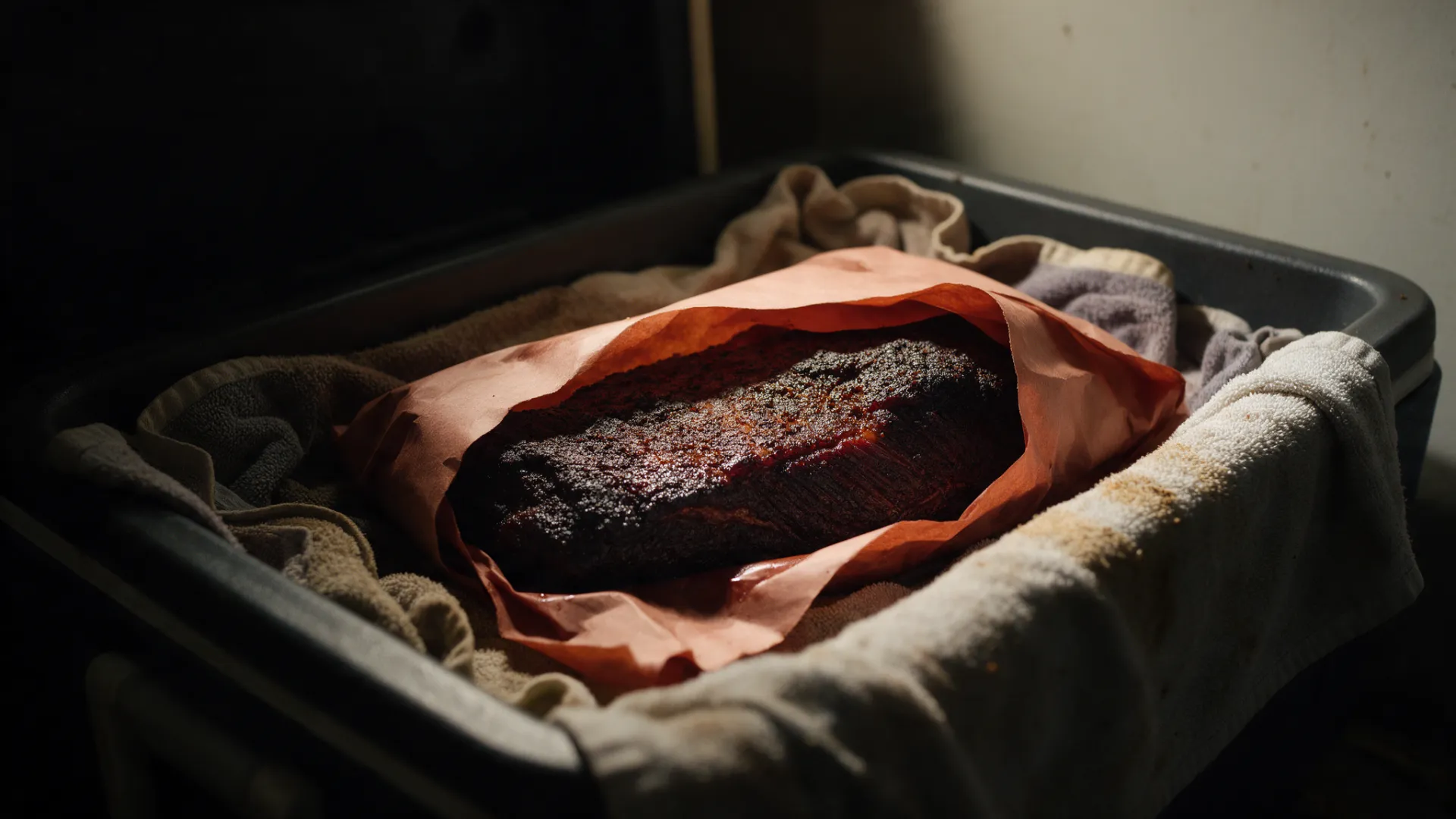
I usually render the fat trimmings on the smoker all the way to the point of wrap. Then I pour the warm tallow over the brisket as I wrap in butcher paper. Adding tallow to the wrap is a habit I picked up watching Texas BBQ pitmasters explain to add tallow for extra juiciness. Maybe it works maybe it doesn't but I just always add it. The research briskets were wrapped in foil, which is faster and softens the bark more. Paper lets more of the sweat out, so it sits much closer to no wrap (butcher paper vs foil vs naked).
Once it's wrapped I take the pit up to about 135°C (275°F).
Backwards from a 6 pm dinner
Fire lit: 5:00 am, 90 minutes to a steady pit and a clear stack
Meat on: 6:30 am, pit 121°C until the wrap
Expect the wrap: about 9:45–11:15 am, once the bark's set, then the pit up to 135°C
Expect probe tender: about 12:30–2:30 pm, allow to 3 pm, start probing the flat at 88°C
Rest or hold, meat at 60°C or hotter: until about 5:30 pm, wrapped, with a probe in the meat
Slice to order: 5:30–6 pm, dinner at 6 pm
- When it happens
- When to expect it
- Allow for a slow one
How long does it take?
Plan on 6–8 hours for a whole point end, then the rest. In a 2024 study, whole Australian and US briskets at 121°C took 6.0 to 7.9 hours (Johnston et al.). An Australian study at 120°C averaged about 7 hours, anywhere from 4 to 10.
Don't work it out by the kilo. My 1.7 kg flat took 8½ hours on a cooler pit and my 2.1 kg flat took 6. The pit and the piece matter more than the weight. So aim to finish early, because a brisket can sit wrapped a lot easier than a dinner can wait.
Here's a worked example for a 5 kg trimmed point end on a 121°C pit, if you want it on the table at 6 pm. Your pit and your brisket will vary.
| Step | Time |
|---|---|
| Fire lit | 5:00 am |
| Meat on | 6:30 am |
| Expect the wrap | about 9:45–11:15 am |
| Expect probe tender | about 12:30–2:30 pm, allow to 3 pm |
| Rest or hold, meat at 60°C or hotter | until about 5:30 pm |
| Slice to order | 5:30–6 pm |
When is it done?
Start probing the flat at about 88°C (190°F) and go by feel. It's done when the probe slides into the thickest part of the flat like a knife through hot butter, with hardly any resistance. On my cooks that's been 92–94°C (198–201°F), and the research briskets were pulled at 93°C (199°F). Franklin says "often" 95°C (203°F).
A lot of people rely on temp alone, which is fine, each to their own. But temp probe alone is risky because it fixes your mind on achieving a set number. Sometimes a brisket is done at 91°C (196°F), sometimes it's done at 97°C (207°F). One of mine was overcooked even though the probe read 96°C (205°F). If there's still a touch of resistance that's ok if you are long holding, as the collagen conversion continues to happen as the brisket's internal temp falls to the holding temp. That's for a fatty point end though. A lean flat shouldn't be pulled early and held for hours.
Gate it on the flat. The lean side lags on the pit, and the point is fattier and more forgiving. Why the probe beats the number is in why low and slow works, and where to put it is in where to put the probe.
Rest it, or hold it
Rest it wrapped. At the end of a long cook a brisket barely climbs, about 2°C on one of mine, so you're not waiting for it to finish. If it's done early, keep it wrapped and keep the meat itself at 60°C (140°F) or hotter with a probe in it. I set the hold oven to 65°C (149°F) and slice to order so it stays hot and juicy. A hot hold keeps cooking it though, so a lean flat shouldn't sit for hours. My 26 July flat sat at about 72°C (162°F) for two hours or more and came out dry (resting and holding a brisket).
Slicing the two muscles
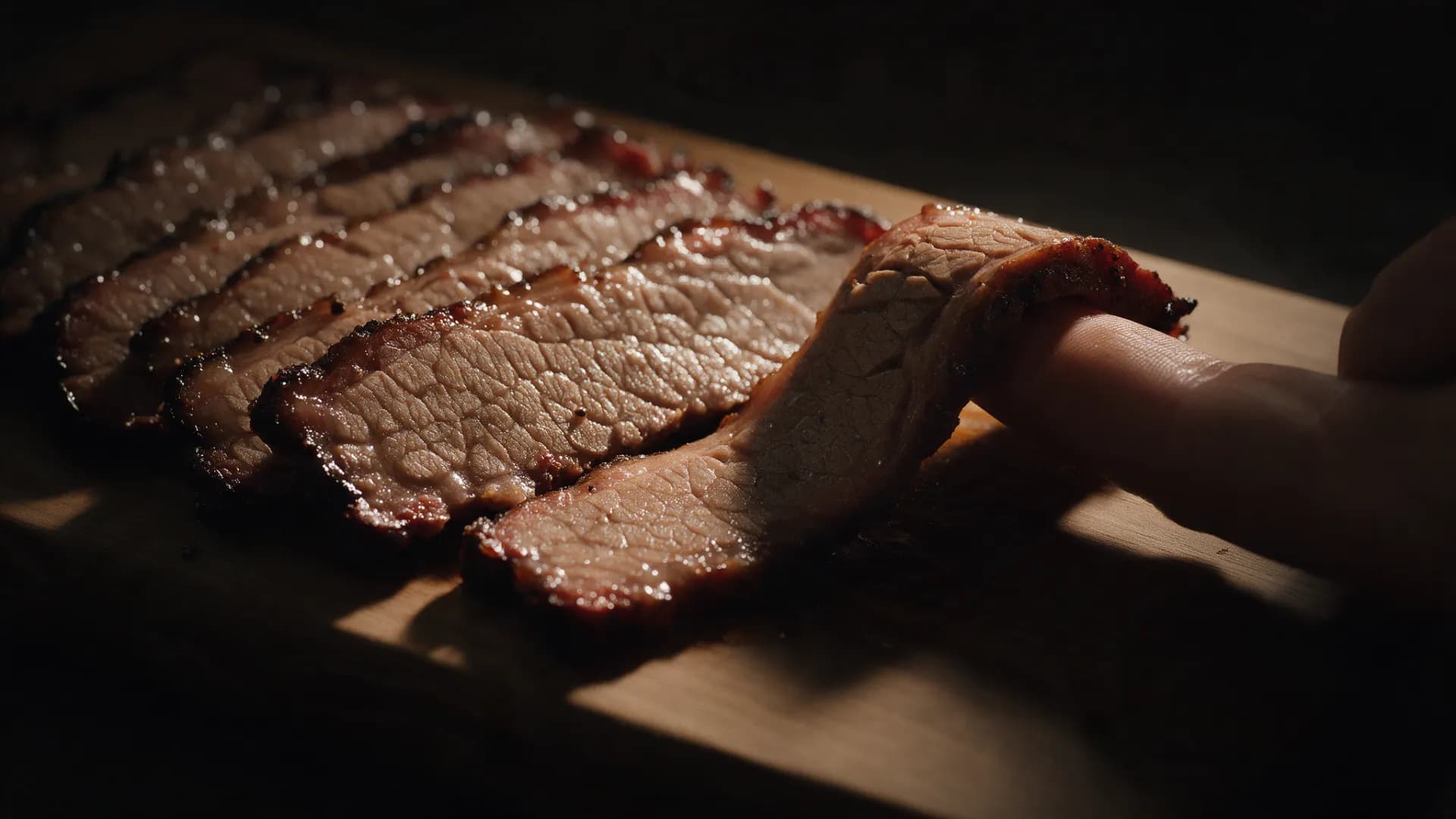
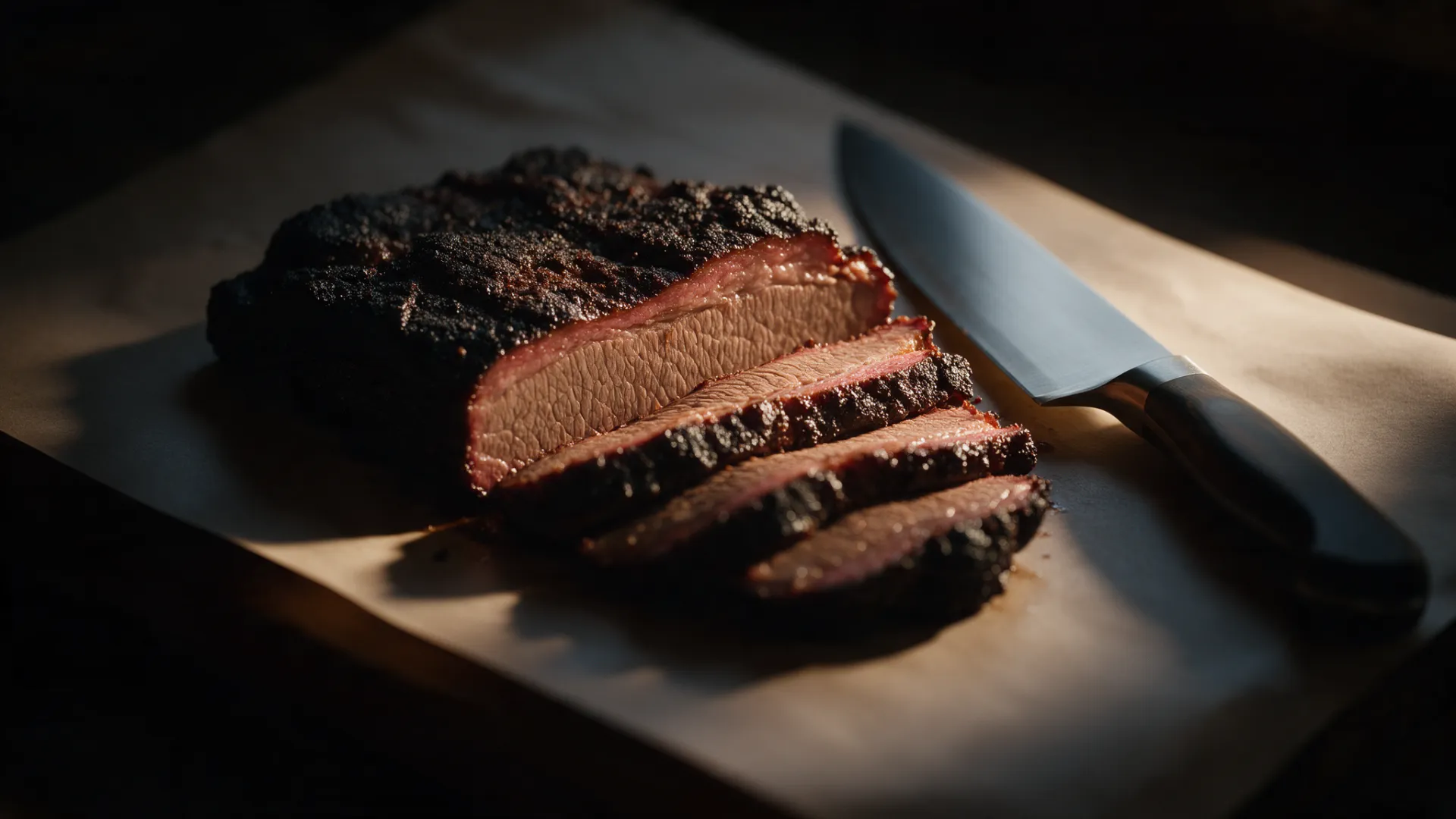
Separate the point from the flat along the fat seam. Slice the flat across its grain about pencil thick, around 6 mm, using your notch. Then turn the point, because its grain runs a different way, and slice across that. Franklin cuts the point a bit thicker, about 10 mm, and doesn't separate them first. Both work.
Only slice what's being eaten now. I reckon the cut faces dry out and go grey while they wait. Pour the juice off the board and out of the paper back over the slices, it's the brisket's own juice and fat.
No thermometer at the table? A pencil-thick slice should drape over your finger without breaking. If it crumbles it went too far. If it's tough, check whether it's wet or dry, which why is my brisket dry? sorts out.
Leftovers
It's best the day it's cooked. In Johnston's 2024 study, brisket chilled and reheated a week later scored lower on every trait than brisket served the same day. With leftovers I'll often rewarm them in a bath of gravy and make up sandwiches. Or I'll put the leftovers on a pizza, make a pasta dish or sometimes just eat it cold!
Quick answers
What do I ask for at an Australian butcher if a US recipe says "packer brisket"?
Ask for a brisket point end, or "point end deckle off" if you want the hard inside fat removed. On the AUS-MEAT specifications that piece holds both muscles US recipes call the flat and the point. The navel end is a different, thinner cut from further back. Some butchers use the names loosely, so check by eye: two muscles with a seam of fat between them.
How long does a brisket take at 121°C?
Plan on six to eight hours for a whole point end, then a rest. In one study, whole Australian and US briskets smoked at 121°C (250°F) took 6.0 to 7.9 hours, and an Australian study at 120°C averaged about 7. Don't work it out by the kilo, because the weight is a poor guide. Aim to finish early and hold it.
What temperature is brisket done?
Usually somewhere around 92–94°C (198–201°F), but the number isn't the test. Start checking at about 88°C and pull it when a probe slides into the thickest part of the flat with almost no resistance. In two brisket studies the researchers pulled at 93°C. One of my briskets came out overcooked at 96°C, so don't wait for a number.
Should I wrap brisket in butcher paper or foil?
Either works. Foil traps more steam, so it finishes faster and softens the bark more. Butcher paper lets some of the brisket's sweat escape, so the bark stays firmer, though it's slower than foil. Nobody's timed by how much. The research briskets were wrapped in foil. I use butcher paper with warm tallow from the trimmings. Whichever you use, wait until the bark has set.
For the curious
The two muscles are the pectoralis profundus (the flat) and the pectoralis superficialis (the point). In the US the whole brisket is IMPS 118–120 in the USDA's specifications, which matches the AUS-MEAT brisket point end. On its own the US flat is AUS-MEAT 2328 Pectoral and the point is 2327 Point End Plate. The navel end is 2339–2345.
The 121°C, 6–8 hour, 38–41% loss numbers are from Johnston et al. 2024, which smoked MSA-graded Australian and USDA briskets. The Australian point ends and the Australian-versus-Texan tasters are Lees et al. 2024. What a hot hold does to yield is Kerth et al. 2025. Franklin's method is in Franklin Barbecue: A Meat-Smoking Manifesto (2015). The food-safety numbers follow FSANZ, Queensland Health and Food Safety Information Council guidance, checked 26 October 2026.
If you're between Rockhampton and Bundaberg and would rather someone else got up at 5 am to light the fire for your next event, that's what I do. Get a rough price →